AI news roundup for August 1, 2026: agents move into production as Meta pushes transparency and OpenAI, Google, Perplexity, and xAI harden execution
If you want the useful AI news for August 1, 2026, here is the short version: the main story is no longer only model quality. The most practical updates are about background execution, tool connections, prompt governance, separated permissions, transparency for AI-generated media, and keeping agents useful without losing human control.
Published August 1, 2026 · Checked August 1, 2026 · Reading time: 11 min
Practical summary
A practical AI news roundup for August 1, 2026 covering OpenAI, Google, Meta, Microsoft, Mistral, Anthropic, Perplexity, xAI and NVIDIA from official sources published between July 7 and July 28, 2026.
This content helps you
- understand the topic without jargon
- see concrete use cases
- spot common mistakes
- move forward with a simple method
What is covered
- 1The 30-second answer
- 2What was announced
- 3What the new capability can do
- 4Practical examples
- 5Who may benefit
Section 01 · guide
The 30-second answer
OpenAI is positioning ChatGPT Work as a multi-step execution layer and Presence as a controlled enterprise agent product. Google is making Gemini more usable for real workflows with background tasks, remote MCP and cheaper Flash models in GA. Meta adds an important regulatory transparency signal around AI-generated content, Perplexity and xAI strengthen agent execution, Mistral and Microsoft push governance and sovereignty, Anthropic verticalizes Claude for education, and NVIDIA is building an open security layer around AI systems.
The useful question is not whether the announcement looks impressive. It is whether the feature improves a real task, saves time after review, fits the budget and keeps important decisions under human control.
Section 02 · guide
What was announced
OpenAI is pushing a more operational view of AI-assisted work. On July 9, 2026, OpenAI launched ChatGPT Work as an agent that can act across apps and files, stay on a project for hours, and run Scheduled Tasks for one-off, recurring or event-driven work. On July 22, 2026, Presence added an enterprise layer for voice and chat agents with evaluations, approved actions and human escalation. Then, on July 27, 2026, OpenAI Economic Research added a broader signal: 16.8% of work-related messages and 43.5% of occupation-specific messages already concern tasks associated with another role.
Google is closing several common gaps in agent architecture. On July 7, 2026, Google announced background execution, remote MCP servers, custom functions and credential refresh for Managed Agents in the Gemini API. On July 21, 2026, Gemini 3.6 Flash and Gemini 3.5 Flash-Lite moved into general availability with a clear positioning: lower the cost and verbosity of subagents while keeping useful planning behavior for production workflows.
Meta is no longer only talking about assistants that answer questions, but also about platform transparency. On July 24, 2026, Meta explained how Meta AI can plan, connect to email and calendar apps, run research and produce outputs such as slides. On July 28, 2026, Meta also confirmed it would sign the European AI Act code of practice on transparency for AI-generated content. For marketing, media and product teams, that is a reminder that useful AI workflows also have to handle labeling, provenance and user understanding.
Perplexity and xAI are making agents more executable and more scalable. On July 27, 2026, Perplexity added role-based access controls, an API credential vault and Brain for Max to Computer. On July 23, 2026, xAI announced that Grok Build can write and launch workflows that distribute a task across hundreds of parallel agents, then verify and synthesize the result. This is no longer just enhanced conversation. It is work orchestration.
Microsoft and Mistral are putting governance at the center. On July 21, 2026, Microsoft and Mistral expanded their partnership to bring Mistral models into Foundry, Copilot Studio and Azure with options ranging from cloud to fully disconnected environments. On July 9, 2026, Mistral also added a system of record in Studio so prompts and skills can be versioned, assigned and traced. For regulated organizations, the main question is not only which model to use, but how to prove which instruction ran, where, and under which controls.
Anthropic and NVIDIA are advancing in two sensitive areas: domain specialization and security. On July 14, 2026, Anthropic launched Claude for Teachers with free premium access for verified U.S. K-12 educators, teaching skills and curriculum connectors. On July 27, 2026, NVIDIA launched the Open Secure AI Alliance to pool open AI safety and security tooling. Apple, Adobe and DeepSeek remain on the watchlist, but they do not lead this August 1, 2026 roundup because we did not retain a more recent and equally actionable official announcement from them in this editorial window.
Section 03 · method
What the new capability can do
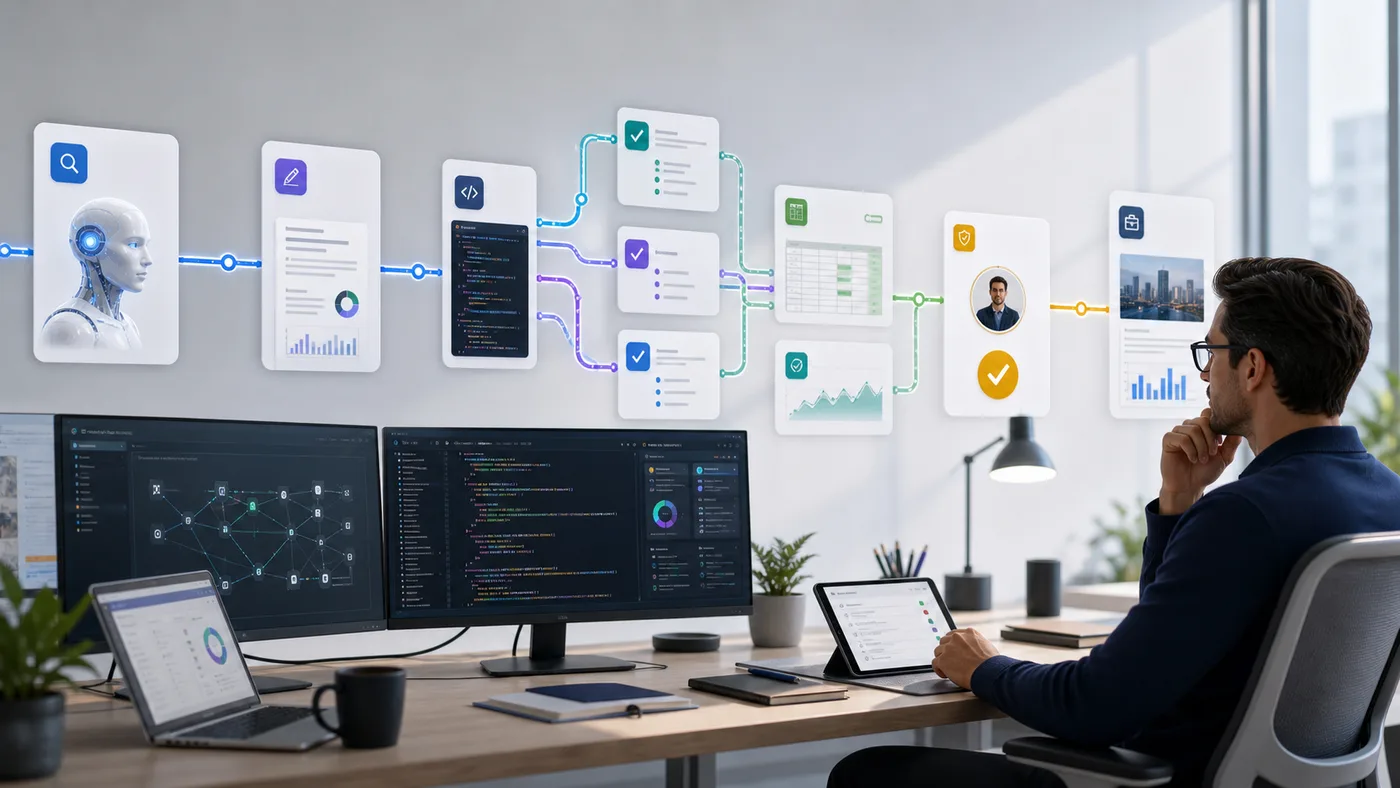
- 1Run an agent in the background and resume the result later instead of blocking one live session.
- 2Connect an agent cleanly to remote tools, files, web apps or MCP servers with separated permissions.
- 3Industrialize multi-step workflows with memory, roles, dedicated credentials, approvals and logs instead of one isolated prompt.
- 4Reduce the cost of agentic workflows by reserving smaller models for repetitive or triage subtasks.
- 5Version prompts and skills as auditable production assets instead of scattered instructions.
- 6Add provenance, transparency or security controls around AI-generated content and AI-triggered actions.
Section 04 · method
Practical examples
A feature becomes valuable when it fits a repeatable workflow. These examples show the difference between a polished demo and work that can be used every week.
- 1A sales team asks ChatGPT Work to monitor CRM and email signals, then refresh a morning priority dashboard with the accounts that need follow-up.
- 2A product team starts a Gemini Managed Agent in the background to audit a repository, classify critical TODOs and return with a report several minutes later.
- 3A marketing team uses Meta AI to prepare a brief and slide outline, then adds an internal check for AI-content labeling before publication.
- 4An operations team gives Perplexity Computer a research task with role-based permissions and a dedicated credential vault instead of exposing shared employee access.
- 5An engineering team asks Grok Build to split a large pull request review across several agents, then verify and rank the findings before final synthesis.
- 6A school pilots Claude for Teachers to adapt materials by level, analyze classroom data and automate an end-of-day review of student outputs.
Section 05 · method
Who may benefit
- 1Small businesses and operations teams that want to move from chat to a useful recurring process.
- 2Product, data and engineering teams building or supervising tool-using agents.
- 3Regulated organizations that need sovereignty, traceability and separated permissions.
- 4Marketing, content and media teams that must manage provenance and labeling for AI-generated outputs.
- 5Security, compliance and innovation leaders tracking secrets, logs and human approvals.
- 6Sectors such as education where a vertical assistant can become useful faster than a general-purpose agent.
Section 06 · method
Limits and points to check
Official announcements naturally show the strongest use cases. Before adopting the feature, check availability, privacy, reliability, total review time and the actions the system is allowed to take.
- 1ChatGPT Work and Presence are not equivalent products and are not open in the same way. Work depends on plan access and connected plugins, while Presence remains in limited availability for eligible enterprise customers.
- 2Managed Agents, remote MCP and background execution do not remove permission, secret, supervision or cost problems. They mostly make them more visible.
- 3Meta signing the European transparency code does not replace an internal publication policy or a full legal review in your own context.
- 4Perplexity Computer and Grok Build workflows can accelerate a bad source, a weak framing decision or a permission mistake if final verification is weak.
- 5Claude for Teachers targets verified U.S. K-12 educators. Its launch does not imply immediate availability across every market or educational use case.
- 6The sovereignty narrative around Microsoft and Mistral does not remove the need for security review, budget validation or better data and prompt quality.
Section 07 · method
How to test it without disrupting your workflow
- 1Choose a recurring workflow with an easy-to-verify output: reporting, document review, sales preparation, content audit or operational summary.
- 2List what the agent may read, call, modify, send or trigger before connecting internal tools or data.
- 3Compare total time including review across a manual method, a single-agent method and a background-execution method.
- 4Keep the prompt version, skill version, model, permissions and consulted sources so you can explain a result or roll back.
- 5Add a provenance or labeling check if the workflow produces images, videos, slides or publicly distributed content.
- 6Explicitly test escalation cases: refused action, missing source, expired credential, role confusion or required human approval.
Section 08 · guide
What this signals for the next stage of AI
As of August 1, 2026, the market is converging on a simple question: who can provide AI that acts over time with manageable cost, logs, permissions and understandable safeguards?
The next durable advantage will not come only from the strongest model. It will come from platforms that combine durable execution, governance, provenance and continuous observability without turning the system into something a normal team cannot operate.
Section 09 · guide
Official sources
This article is based on official announcements and documentation available on the publication date. Features, pricing and availability may change after publication.
Sources and useful reading
- OpenAI: ChatGPT is now a partner for your most ambitious work
- OpenAI: Introducing OpenAI Presence
- OpenAI: How AI is expanding what people do at work
- Google: Expanding Managed Agents in Gemini API
- Google AI for Developers: Gemini API release notes
- Meta: Meta AI Doesn't Just Think, It Acts
- Meta: Meta is Signing the EU AI Act Code of Practice on Transparency of AI-Generated Content
- Perplexity: Changelog
- xAI: Workflows in Grok Build
- Microsoft: Microsoft and Mistral expand strategic partnership
- Mistral: Your Prompts and Skills need a system of record
- Anthropic: Introducing Claude for Teachers
- NVIDIA: Industry Leaders Unite in Open Secure AI Alliance for AI Safety and Security
Frequently asked questions
What is the main AI news signal on August 1, 2026?
The biggest signal is not another benchmark. It is the harder production layer around agents: long-running execution, remote tools, role separation, versioned instructions, content transparency and human supervision.
Which product is the best first pilot?
For a non-technical or hybrid team, ChatGPT Work is the most concrete entry point. For a more developer-heavy team, Managed Agents in the Gemini API is highly relevant for testing asynchronous execution, remote MCP and the cost-capability tradeoff.
Why include AI-content transparency in an article about agents?
Because an agent that creates, adapts or publishes content is not just a text engine. It becomes part of distribution. At that point, provenance, labeling and user understanding become product and compliance requirements, not just communications debates.
Why are Apple, Adobe or DeepSeek barely visible in the August 1, 2026 article?
They remain important AI players, but this roundup prioritizes recent official announcements that are directly actionable within the retained editorial window. On August 1, 2026, the strongest practical signals were mainly about agent execution, governance and transparency from OpenAI, Google, Meta, Perplexity, xAI, Mistral, Microsoft, Anthropic and NVIDIA.
Related guides
AI automation for business in 2026: where to start without choosing the wrong project
The practical 2026 use cases that save time: email, quotes, reporting, support, documents and admin work.
ChatGPT for small businesses in 2026: 15 use cases that are actually worth it
Simple ChatGPT uses for small businesses: email, procedures, reporting, HR, quotes, support and meetings.
Agentic AI explained: what it is and why people talk about it in 2026
Understand agentic AI with simple examples: goals, tools, actions, human validation and limits.
Microsoft Copilot AI: understand license cost before paying
Evaluate Copilot licenses by real usage, user profiles, alternatives and return on time saved.
Free AI tools
Use the free English tools to prepare prompts, emails, CVs and automation plans without starting from a blank page.
Explore tools